EXECUTIVE SUMMARY
- Core Innovation: Embodied intelligence is the final frontier.
- Market Impact: Labor shortages in manufacturing and logistics are the primary economic driver.
- The Verdict: The convergence of Generative AI and Robotics will give us 'General Purpose Robots'.
The Rise of Humanoid Robots: Tesla Optimus vs Boston Dynamics represents one of the most significant developments in the Robotics landscape today. Embodied intelligence is the final frontier. It is one thing to have an AI that can write a poem; it is another entirely to have one that can fold laundry or navigate a cluttered warehouse. For decades, Moravec's paradox held true: high-level reasoning was easy for computers, but low-level sensorimotor skills were impossibly hard. That is finally changing.
In this comprehensive analysis, we explore the historical context, technical underpinnings, market dynamics, and real-world case studies that define this pivotal moment. Whether you are an investor, a developer, or a policy maker, understanding these dynamics is essential for navigating the AI era.
1. Historical Context: How We Got Here
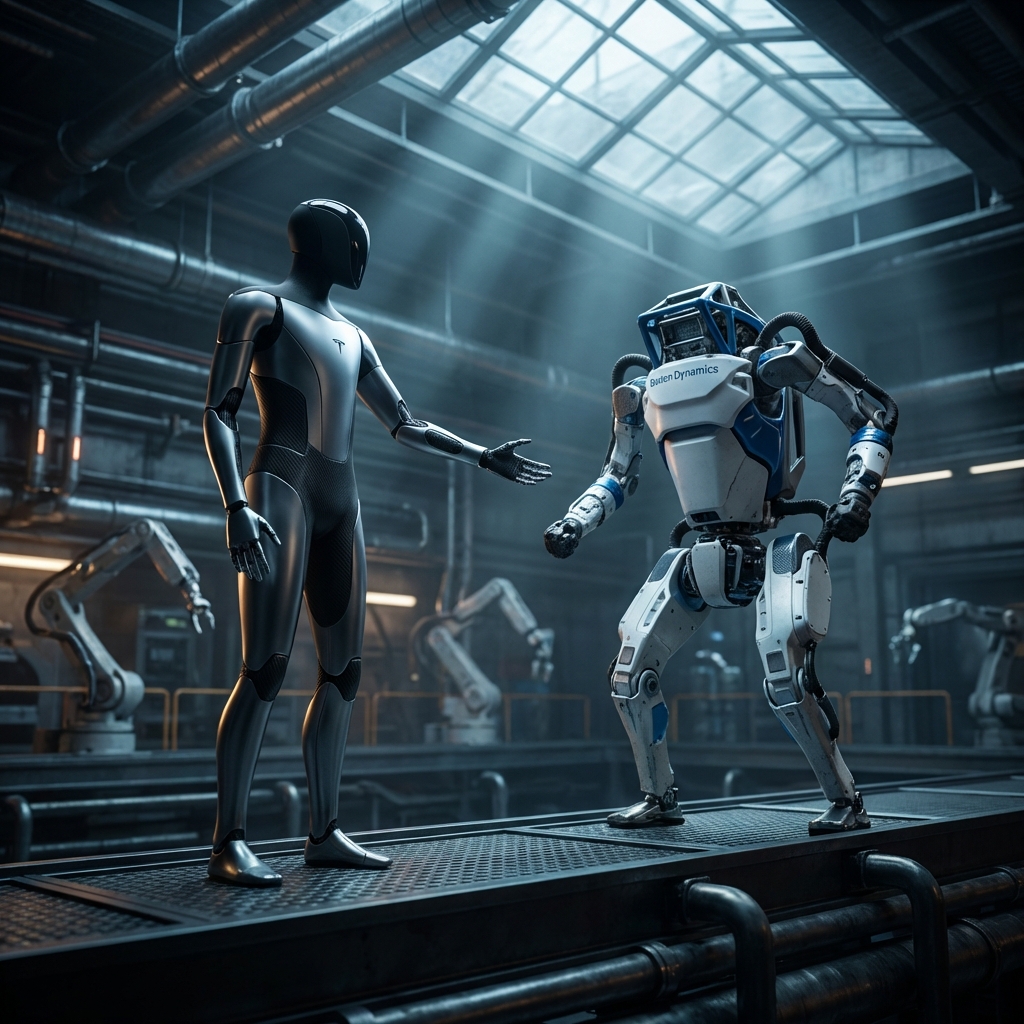
Traditional robotics relied on hard-coded controls and strict environments like cages in car factories. The breakthrough came with the application of deep learning to computer vision and motion planning. Boston Dynamics showed us what was physically possible with hydraulics, but the new wave of humanoid robots from Tesla (Optimus) and Figure AI use neural networks to learn movement from video demonstrations.
This evolution was not linear—it was a series of step-functions. Each breakthrough unlocked new capabilities that were previously thought impossible, leading us to the inflection point we face today. Understanding this history is essential for anticipating what comes next.
2. Technical Deep Dive: Under the Hood
The integration of Vision-Language-Action (VLA) models allows robots to understand semantic commands like 'pick up the red apple' and translate them into motor actuation. Unlike legacy robots that needed precise coordinates, these systems use end-to-end learning. They don't calculate trajectory physics explicitly; they intuit it based on training data, similar to how a human catches a ball without consciously solving differential equations.
The convergence of hardware acceleration and algorithmic innovation has reduced the cost of AI by 100x in the last 18 months, making Robotics commercially viable at unprecedented scale. This is the defining economic force of our era.
3. Market Analysis & Economic Impact
Labor shortages in manufacturing and logistics are the primary economic driver. With aging populations in the West and China, there literally aren't enough humans to fill predominantly physical roles. The concept of 'Robots as a Service' (RaaS) is gaining traction, allowing warehouses to rent fleets of labor rather than making massive capital expenditures on hardware that may become obsolete.
We are witnessing a capital rotation of historic proportions. The winners of this cycle will likely define the global economy of the 2030s. The organizations that move decisively now will have structural advantages that are difficult to overcome later.
4. Real-World Case Study
Amazon's deployment of Digit (by Agility Robotics) in their fulfillment centers is a prime example. These bipedal robots are designed to work in spaces built for humans, navigating stairs and tight corridors. Unlike wheeled robots, they can adapt to the existing infrastructure. Early pilots show they can augment human throughput by handling repetitive lifting tasks, reducing injury rates by over 30%.
This is not a hypothetical future—it is a present reality. Companies that ignore these case studies risk obsolescence. The "wait and see" approach is the most dangerous strategy in an exponential market where competitive advantages compound rapidly.
5. Challenges and Considerations
Battery density is the bottleneck. A humanoid robot needs to operate for an 8-hour shift to be commercially viable, but current power sources often limit high-performance operation to 2-4 hours. There is also the 'Uncanny Valley' effect; as robots look more human but move slightly imperfectly, they elicit a psychological revulsion response that affects consumer acceptance.
These challenges are not insurmountable, but they require deliberate effort. The organizations and policymakers that engage seriously with these difficulties will be better positioned to capture the benefits of this technology while managing its risks.
6. Future Projections (2025-2030)
The convergence of Generative AI and Robotics will give us 'General Purpose Robots'. Instead of being programmed for one task like welding, a robot will be able to download a new skill from the cloud—cooking today, gardening tomorrow. We anticipate the first mass-market consumer home robots to arrive before 2030, at a price point comparable to a mid-range car.
As we look to the horizon, three key trends will dominate the next five years:
- Scalability: Models will become dramatically more efficient, enabling deployment on edge devices and in resource-constrained environments.
- Ubiquity: AI capabilities will be embedded in every software product and physical device, becoming invisible infrastructure.
- Autonomy: The transition from AI as a tool to AI as an agent—systems that pursue goals, not just answer questions—will reshape every industry.
Conclusion
In the final analysis, The Rise of Humanoid Robots: Tesla Optimus vs Boston Dynamics is a gateway to the next era of human capability. The organizations that master this domain will define the economy of the 2030s. The question is no longer if you will adapt, but how fast—and whether you will lead or follow.
Stay tuned to AI Trend Global as we continue to track this rapidly evolving story with the depth and precision it deserves.